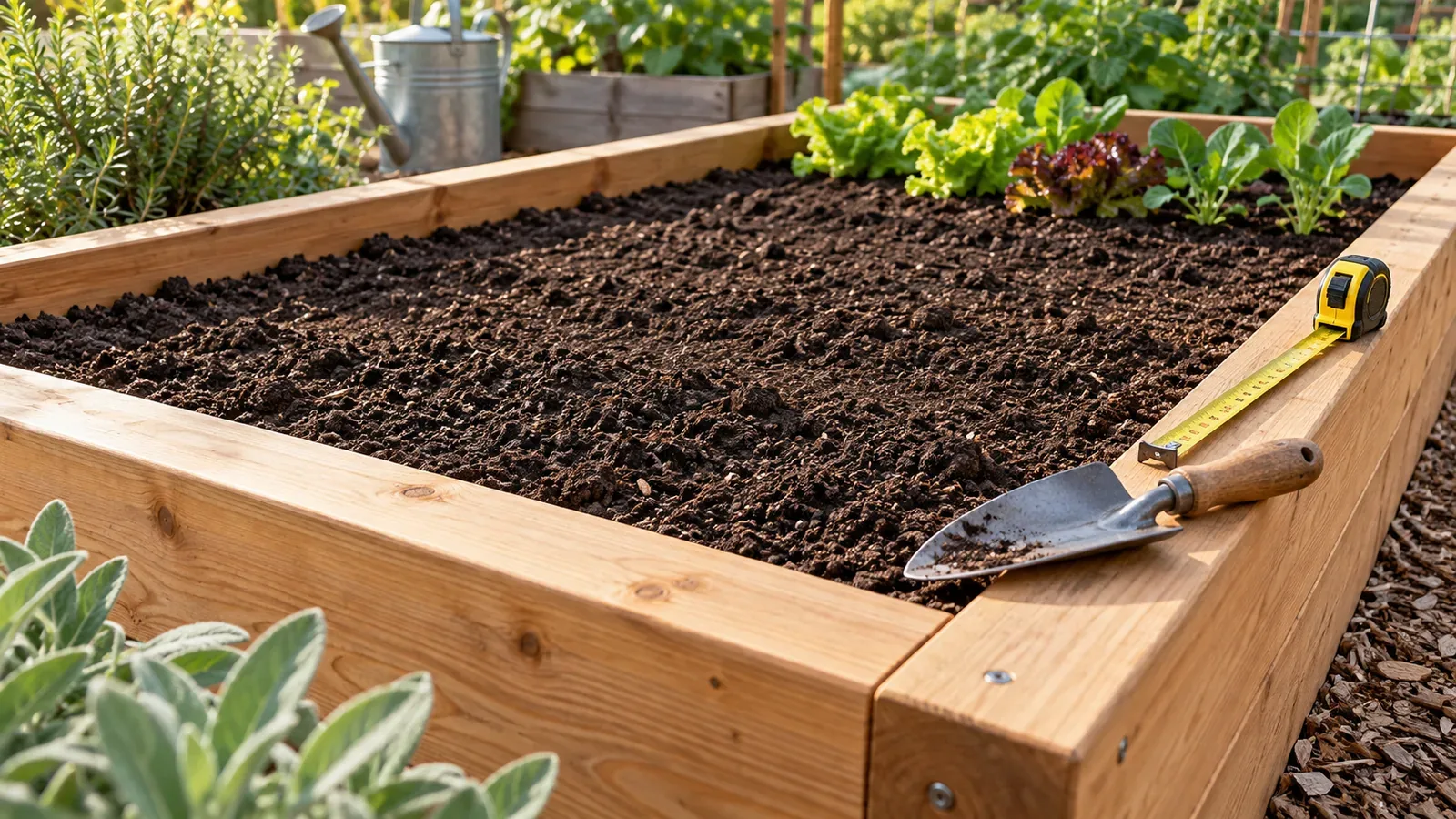
An empty raised bed makes a small garden project look surprisingly large. You know the frame’s dimensions, but the soil is sold in bags, cubic feet or cubic yards. Before buying a stack of bags, work out the space you actually need to fill.
For a rectangular raised bed, multiply the inside length by the inside width, then multiply by the fill depth in feet. Divide the result by 27 for cubic yards, or by the volume on your chosen bag to get a bag count. Add any agreed allowance separately, then round the final bag count up.
The MyDIYCalc raised bed soil calculator handles the basic volume calculation. This guide explains what to measure, how to read its separate allowance and how to turn the result into a useful shopping list.
Quick answer: how much soil does a 4 × 8 raised bed need?
A bed measuring 4 ft × 8 ft on the inside, filled 12 inches deep, holds 32 cubic feet. That is about 1.19 cubic yards, or 22 bags of 1.5 cu ft, rounded up. These are base quantities before an extra allowance.
The same frame filled to a different depth needs a different amount. Use your intended fill depth rather than assuming every 4 × 8 bed takes the same order.
| Fill depth | Base volume | Cubic yards | 1.5 cu ft bags |
|---|---|---|---|
| 6 in | 16 cu ft | 0.59 | 11 |
| 10 in | 26.67 cu ft | 0.99 | 18 |
| 12 in | 32 cu ft | 1.19 | 22 |
| 18 in | 48 cu ft | 1.78 | 32 |
All rows assume an inside footprint of 4 × 8 ft. Bag counts are rounded up from the unrounded volume. These depths are calculation examples, not a recommendation for every crop or bed design.
Measure the space the new soil will occupy
Use inside dimensions
Measure between the inner faces of the frame. Outside dimensions include the timber or metal edges, which do not hold soil. A product advertised as “4 × 8” may describe its overall footprint, so check the actual interior.
For instance, an interior measuring 7.5 × 3.5 ft holds 26.25 cu ft at a 12 inch fill depth. Using 8 × 4 ft would give 32 cu ft, an overestimate of 5.75 cu ft before any allowance. Measuring inside can make a noticeable difference to the order.
Measure fill depth, not just frame height
Decide where you want the finished soil surface. If a frame is 14 inches high but you plan to leave 2 inches of space at the top, the fill depth is 12 inches. Enter 12 in the calculator.
If soil is already in the bed, measure the gap between its current surface and the intended finished level. An existing 4 × 8 ft bed needing a 3 inch top-up takes 8 cu ft before allowance, not the 32 cu ft needed for a full 12 inch fill.
Check the gap at several points. Divide noticeably uneven areas into sections and estimate them separately. If your planned soil order fills only one part of a deeper bed, use the depth of that part. This measures a chosen design; it does not establish that a particular lower filling material is suitable.
The formula, with a complete worked example
Cubic feet = inside length (ft) × inside width (ft) × fill depth (in) ÷ 12 × number of identical beds.
For one 8 × 4 ft bed filled 12 inches deep:
- Convert depth: 12 ÷ 12 = 1 ft.
- Calculate volume: 8 × 4 × 1 = 32 cu ft.
- Convert to cubic yards: 32 ÷ 27 = 1.185… cu yd, displayed as 1.19.
- For 1.5 cu ft bags: 32 ÷ 1.5 = 21.333… bags, rounded up to 22.
Keep the unrounded volume for later calculations. The displayed 1.19 cubic yards is convenient for reading, but repeatedly converting rounded numbers can introduce small differences.
The calculator’s “Number of beds this size” field is for identical dimensions. Two beds of this example size need 64 cu ft in total, or 43 bags of 1.5 cu ft. Combining the volume before rounding gives 43 bags; rounding each bed to 22 bags first would give 44.
For different-sized beds, calculate each separately, add their volumes and divide the total by the bag size. Combine orders only where the beds use the same material.
Read the 15% allowance correctly
The current MyDIYCalc tool shows a separate result labelled “With 15% settling allowance.” It multiplies the base volume by 1.15. This is a fixed comparison, not a prediction that your soil will settle by exactly 15%.
For the 32 cu ft example, that separate result is 36.8 cu ft, or about 1.36 cu yd. The tool’s base bag result still says 22 bags because it does not include the extra 15%.
If you decide to purchase the allowance volume in 1.5 cu ft bags, calculate it separately: 36.8 ÷ 1.5 = 24.533… bags, rounded up to 25 bags. Those bags contain 37.5 cu ft in total because whole packages cannot match every target exactly.
Choose any allowance with your supplier and the material in mind. Keep it visible on the order rather than adding one percentage to the volume and another to the bag count. Do not pile extra soil above the planned fill line simply because you bought an allowance.
Match the bag count to the package you are buying
The tool assumes 1.5 cu ft per bag. If the product has a different volume, divide your chosen target volume by that package volume instead.
| Volume per bag | Bags for 32 cu ft | Volume supplied |
|---|---|---|
| 1 cu ft | 32 | 32 cu ft |
| 1.5 cu ft | 22 | 33 cu ft |
| 2 cu ft | 16 | 32 cu ft |
| 3 cu ft | 11 | 33 cu ft |
This table uses the base volume, without the optional allowance. A larger package changes how many bags you carry; it does not change the space in the bed.
For bags labelled in liters, use 1 cu ft ≈ 28.3168 liters. The 32 cu ft example is about 906.14 liters. Dividing by 40 liters per bag gives 22.65 bags, so you would buy 23 bags for the base volume.
A label stating only pounds or kilograms is not enough for this calculation. Weight and volume describe different things, and moisture and material composition affect their relationship. Ask for the package’s stated volume rather than assuming every bag of a given weight fills the same space.
Choose the growing medium as well as the quantity
A volume calculator cannot tell whether the material suits your plants and bed. The University of Minnesota Extension’s raised bed guide discusses topsoil and plant-based compost blends, as well as bagged raised bed mixes. It also explains why adding too much compost can create problems.
Confirm the material for your particular setup before ordering. An open-bottom garden bed and an elevated planter may have different requirements. For an elevated planter, check its manufacturer’s instructions for the medium and permitted load.
If you have already chosen a blend, divide the total volume into its agreed proportions. As an arithmetic example, a 60:40 split of 32 cu ft is 19.2 cu ft of one component and 12.8 cu ft of the other. Those numbers add to 32; they are not a universal soil recipe.
A ready-blended product is counted as the full growing-medium volume. Do not buy 32 cu ft of a complete blend and then add another full component order unless the plan actually calls for it.
Compare bags and bulk on the same basis
Ask the bulk supplier for the material description, unit of sale, order increments and delivered price. A cubic yard is 27 cubic feet. A supplier’s informal “yard” should be confirmed as a cubic yard, rather than a bucket, scoop or truckload of unspecified volume.
For a fair comparison, price the same target volume and suitable material in both formats. Include delivery, any minimum order and the practical work of moving it into the beds. A lower price per unit does not necessarily produce the lower total for a small order.
Confirm where the load can be dropped and how you will reach the beds. If ordering by weight, ask the supplier to relate its specific material to your required volume; the calculator does not convert soil volume into tons.
Keep the measurements, material choice and delivery details together in your DIY materials checklist. That makes a later change of bed size much easier to trace.
Keep mulch and soil as separate quantities
If your plan includes a surface mulch layer, record that layer separately from the growing medium. For example, 2 inches over a 4 × 8 ft surface occupies about 5.33 cu ft. That is a volume example, not a suggested mulch depth for every planting.
Use the mulch calculator for that separate order, and read the mulch depth guide when deciding on the layer. If you reserved part of the frame for mulch, do not count the same space again as soil.
Raised bed soil FAQs
How many bags of soil do I need for a 4 × 8 raised bed?
At an inside fill depth of 12 inches, the base volume is 32 cu ft. That takes 22 bags of 1.5 cu ft or 16 bags of 2 cu ft. Use the actual inside dimensions and package volume. An allowance changes the target volume and should be calculated separately.
Is one cubic yard enough for a 4 × 8 bed?
One cubic yard supplies 27 cu ft. Spread evenly over 32 sq ft, that corresponds to about 10.13 inches of depth before any settling or handling loss. It is less than the 32 cu ft needed for a 12 inch base fill.
Does the calculator’s bag count include the 15% allowance?
No. Its bag count uses the base volume and 1.5 cu ft bags. For the standard 32 cu ft example, the separate allowance volume is 36.8 cu ft, requiring 25 bags of that size if you choose to buy that amount.
How do I calculate soil for a bed that is already partly full?
Measure only the additional depth needed to reach your intended level. Multiply that depth by the bed’s inside footprint. A uniform 3 inch top-up over 4 × 8 ft is 8 cu ft, or 6 bags of 1.5 cu ft before any separate allowance.
Can I subtract the volume of existing material in a tall bed?
Count only the space the new material will occupy, provided the planned layers and rooting depth are suitable for the bed. The calculator does not assess lower materials or how their breakdown will change the level later. Measure the remaining fill space rather than guessing a discount.
Can I use this calculation for a round planter?
The tool’s length and width inputs describe a rectangle. For a straight-sided circular planter, use π × radius² × fill depth, with every dimension in the same unit. Tapered containers need a shape-specific calculation; their outside dimensions alone do not establish their capacity.
Finish with a measured order
Write down the inside dimensions, intended fill depth, base volume, chosen allowance and package size. Then use the soil volume estimator to check the rectangular calculation before you place the order.
The garden and outdoor calculator hub brings the related material tools together when you are also planning paths, borders or surface coverings.
Calculation note: worked rectangular examples were checked against the supplied MyDIYCalc formula. The 15% result is a separate planning allowance. Growing-medium guidance is linked above; actual material choice and settling depend on your setup and the product supplied.